Best Floor Lamps for Reading: Bright, Adjustable, and Easy on the Eyes

Hey There! Some links on InexDecor.com are affiliate links. If you make a purchase through them, we may earn a small commission at no extra cost to you. We only recommend trusted products to support our content. Thank you for your support!
Best Floor Lamps for Reading: Bright, Adjustable, and Easy on the Eyes
The best floor lamps for reading do one job well: they put a focused, glare-free pool of light on the page at the right height, for hours, without tiring your eyes. Most floor lamps fail at it. A torchiere washes the ceiling. A decorative shaded lamp glows prettily and leaves the page dim.
This guide shortlists six lamps that genuinely work, explains brightness, colour temperature, glare, adjustability and stability, and shows where to put the lamp for your chair, sofa, bed or recliner. Our top pick is a dedicated LED lamp with an adjustable gooseneck, in the Brightech Litespan style. If your chair sits away from a wall, an arc lamp is better. If your eyes need serious help, a full-spectrum low-vision lamp is worth the extra cost.

Key Takeaways
- Aim for 450–800 lumens on the page; older eyes should use the higher end.
- Pick 2700K for evening fiction and 3000–4000K for study or small print.
- The bulb or LED should never be visible from your seat.
- A tilting head or bending neck matters more than wattage.
- Place the head 48–60 inches high, over your non-dominant shoulder, from behind.
- For most readers, a gooseneck task lamp beats a torchiere or decorative stand.
- Add low ambient light so the bright page does not sit in a dark room.
Table of Contents
What Makes a Great Reading Lamp? | The 6 Best Floor Lamps for Reading Compared | The Picks in Detail | How to Choose | Bulb Basics | Placement and Height Guide | Specific Reading Setups | Common Mistakes | Budget Tiers and Care | FAQs | Final Verdict
What Makes a Great Reading Lamp?
A reading lamp is not a room lamp. A room lamp fills space with light. A reading lamp delivers light to one small rectangle — the open book in your lap — and keeps the rest of the room calm.
Brightness comes first, but it is brightness on the page, not in the room. Aim for 450–800 lumens reaching the page. Younger eyes are comfortable near 450 lumens; older eyes, small print, and long sessions need 700–800. A dimmer is valuable because the right level changes with the time of day and your tiredness.
Colour temperature is second. Warm light around 2700K feels restful in the evening and suits novels. Neutral to cool light at 3000–4000K gives sharper contrast for study and fine print. Glare control is third, and it is the test most lamps fail. Sit in your chair and look toward the lamp: if you can see the bulb or LED strip, it will glare. Adjustability and stability complete the picture: a tilting head or bending neck lets you aim light as you shift, and a weighted base with a slim footprint keeps the lamp upright without blocking a walkway.

The 6 Best Floor Lamps for Reading Compared
| Lamp | Type | Best for | Standout strength |
|---|---|---|---|
| Brightech Litespan LED | Gooseneck task lamp | Most readers | Aims light precisely on the page |
| Brightech Trilage Arc | Arc multi-head lamp | Chairs away from walls | Reaches over a chair or sofa |
| LEPOWER Metal Floor Lamp | Classic shaded stand | Tight budgets | Simple, takes standard bulbs |
| Verilux SmartLight LED | Full-spectrum task lamp | Low vision / long sessions | High-contrast daylight-style light |
| Brightech Sky LED Torchiere | Uplight torchiere | Readers who also need room light | Dimmable uplight doubles as ambient light |
| BenQ e-Reading Floor Lamp | Premium smart lamp | Serious readers | Very wide, even light with auto-dimming |
Each lamp earns its place for a different reader, room, or budget.
The Picks in Detail
1. Brightech Litespan LED — Best for Most Readers
Who it is for: most readers, in most chairs, in most rooms. The Litespan is a flexible gooseneck task lamp with a focused LED head, and our top pick because it does the core job best. Bend the neck, tilt the head, and the light lands exactly on the page. It suits a chair with a side table, a corner armchair, or a spot beside the sofa. The focused head creates a clear, even pool of light, and the integrated LED means no bulb swapping. The honest limitation: when the LED eventually ends its life, you replace the lamp, not a bulb — a decade away for most buyers.
2. Brightech Trilage Arc — Best for Chairs Away from Walls
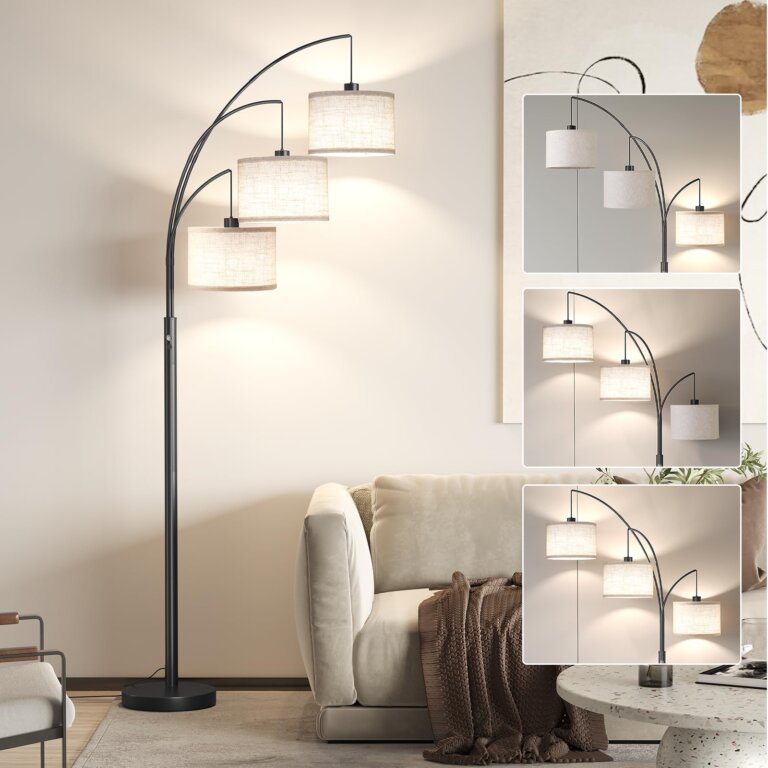
Who it is for: readers whose chair floats mid-room, and households where two people read side by side. The Trilage Arc has three shades on a curved arm that hangs light over the chair, so you do not need a wall or side table behind you. The shades spread light across a sofa or a pair of chairs, making it the social reader’s pick. Its honest limitation is floor space: an arc needs room for its base and sweep, and can dominate a small room if you do not measure first.

3. LEPOWER Metal Floor Lamp — Best for Tight Budgets
Who it is for: readers who want a simple, inexpensive lamp that takes standard bulbs. The LEPOWER is a classic shaded metal stand lamp with an adjustable gooseneck — no app, no smart feature, no integrated LED. Screw in a standard bulb, bend the neck toward your page, and read. That simplicity keeps the price low and makes it easy to change brightness or colour later. An E26 bulb at 800 lumens, 2700K or 3000K, turns it into a genuinely good reading light. The honest limitation is dimming: there is no dimmer unless the bulb provides it.
4. Verilux SmartLight LED — Best for Low Vision and Long Sessions
Who it is for: readers whose eyes need serious light, and anyone who reads for long stretches. The Verilux SmartLight is a full-spectrum task lamp designed to mimic daylight, producing bright, high-contrast light that makes print stand out. For low-vision readers, fine print, and long sessions, that contrast is the difference between reading comfortably and giving up early. The honest limitations are price and feel: it costs more than a basic stand lamp, and its clinical brightness can feel harsh for evening fiction.
5. Brightech Sky LED Torchiere — Best When One Lamp Must Do Two Jobs
Who it is for: readers who also need room light, especially in small living rooms. The Sky Torchiere fires light at the ceiling, which bounces back down as soft, even ambient light. Its wide dimming range lets you raise it for a bright room or lower it for a quiet evening. As a reading lamp it is a compromise — page contrast is softer than a focused task lamp gives — but as a one-lamp solution for a small living room, it is sensible. The honest limitation is that compromise: if you read for hours, you will notice the softer contrast.
6. BenQ e-Reading Floor Lamp — Best Premium Smart Lamp for Serious Readers
Who it is for: serious readers who want the widest, most even light and are happy to pay for it. The BenQ produces a very wide, even ellipse of light that covers an open book, magazine, or laptop without hot spots or dark corners. Its auto-dimming senses the room light and adjusts itself as daylight fades. You stop noticing the lamp at all. The honest limitations are premium pricing and a modern, technical look that will not suit every room.
How to Choose: Brightness, Colour, Glare and Stability
Start with your eyes, not the lamp. If you are under forty and read for pleasure, 450–600 lumens on the page will feel comfortable. If you are older, read small print, or study, aim for 700–800 lumens. Low-vision readers should aim higher and consider a full-spectrum lamp such as the Verilux. A dimmer lets you fine-tune, and is worth paying for. Then choose colour temperature: 2700K for evening fiction, 3000–4000K for study and daytime reading. If you read at both times, look for adjustable colour temperature, or keep two bulbs for a standard-bulb lamp such as the LEPOWER. Finally, check adjustability and stability — a tilting head, a bending neck, a weighted base, and a cord that does not trail across a walkway.
Bulb Basics: E26 Bulbs, Lumens, Colour and CRI
If your lamp takes a standard bulb, the bulb is half the lamp. An E26 bulb at 800 lumens is the sweet spot: 450 lumens suits younger eyes, 1,100 lumens suits low vision. Choose 2700K for evening reading and 3000–4000K for contrast and study. Look for a CRI of 90 or above, so print looks true rather than washed out. Dimmable bulbs need a compatible dimmer — check that pairing first. E26 smart bulbs are also worth considering, giving much of a smart lamp’s benefit without replacing the lamp.
Placement and Height Guide by Chair Type
Put the lamp head 48–60 inches high. Seated eyes sit at roughly 42–48 inches, so the head should sit just above eye level, shining down onto the page. Too low, and the light hits your lap. Too high, and it spills into your eyes. Place the light over your non-dominant shoulder, from behind. If you are right-handed, the lamp goes over your left shoulder; if left-handed, over your right. This keeps your hand from shadowing the page, and keeps the source out of your line of sight.
For an armchair against a wall, put the lamp just behind and to the side, base against the wall, head angled forward. For a bed, place it beside the bed at the same height, with a dimmer. Add a little low ambient light so the bright page does not sit in a dark room. For more whole-room schemes, our guide to designing the perfect living room covers layering task, ambient, and accent light together, and the Lighting hub collects every lighting guide — including how to choose a chandelier for the living room.

Specific Reading Setups: Living Room, Small Apartment, Bed and Recliner
A shared living room needs directional task lamps, not a torchiere alone. Two readers need two pools of light, or one arc lamp with multiple heads, so neither sits in shadow. Our guide to modern living room design with AI in Planner 5D shows how to place seating and lighting together.
A small apartment corner needs a small footprint above all. Reading in bed or in a recliner needs a flexible neck and a dimmer above all, with the lamp opposite your dominant hand. For a bedroom corner, see bedroom design with AI in Coohom; for a home office corner, see modern home office design with AI in Coohom; and for a child’s corner, see modern kids room design with AI in Planner 5D.

Common Mistakes That Tire Your Eyes
First, buying for looks alone: a beautiful lamp that glares, or cannot aim at the page, is a decoration, not a reading lamp. Second, too little light: a dim page forces your eyes to strain, especially with small print. Third, too much contrast: a bright page in a black room, or a bare bulb in your line of sight, tires eyes faster than dim light. Add ambient light and hide the source. Fourth, the wrong height — too low lights your lap, too high lights the wall. Keep the head at 48–60 inches. Fifth, your hand’s shadow: if the lamp is over your dominant shoulder, your hand will shadow the page. Move it to the other side.
Budget Tiers and Care
At a tight budget, a simple shaded stand lamp such as the LEPOWER, fitted with a good E26 bulb, gives genuinely comfortable light. Spend the saving on the bulb: 800 lumens, 2700K or 3000K, CRI 90+, dimmable if possible. At mid-range, a gooseneck task lamp such as the Litespan, or an arc lamp such as the Trilage if seating floats, gives better aiming and glare control — where most readers should spend. At premium, a full-spectrum lamp such as the Verilux, or a smart lamp such as the BenQ, gives the best light available, worth it only if you read daily for hours.
For care, dust the shade and head monthly, as dust dims light. Wipe an LED head with a dry, soft cloth, never spray cleaner onto it. Check the neck every few months: a drooping gooseneck needs repositioning. An integrated LED should last tens of thousands of hours.

Frequently Asked Questions
How many lumens do I need for reading?
You need 450–800 lumens on the page for comfortable reading. Younger eyes are fine near 450 lumens for relaxed fiction, while older eyes and small print need 700–800 lumens. Low-vision readers may need more, and a full-spectrum lamp can help by improving contrast as well as brightness. A dimmer is useful because the right level changes with the time of day and how tired your eyes are.
Warm or daylight bulb: which is better for reading?
Choose 2700K warm light for relaxed evening fiction, because it feels restful and does not fight your wind-down. Choose 3500–4000K neutral to daylight light for study, textbooks, and fine print, because the cooler tone gives sharper contrast. If you read at both times, pick a lamp with adjustable colour temperature, or use a standard-bulb lamp and keep two bulbs on hand.
Arc or pharmacy style: which is better for reading?
A pharmacy or gooseneck style is the most focused choice, because it aims a tight pool of light directly at the page. Choose it when your chair is against a wall or beside a table. Choose an arc lamp when your chair sits away from the wall, or when two people read side by side, because the arc reaches over the seating and spreads light more widely.
How long do LED reading lamps last?
LED reading lamps last tens of thousands of hours, which is over a decade of normal daily reading. That is far longer than an old incandescent bulb, and it means you will rarely think about replacement. The trade-off is that an integrated LED cannot be replaced when it eventually fails, so you replace the lamp itself. A standard-bulb lamp avoids that, at the cost of occasional bulb changes.
Are smart floor lamps worth it?
A smart bulb gives you about 90 percent of the benefit of a smart lamp, including dimming and colour-temperature control, for much less money. A dedicated smart lamp earns its premium only with features a bulb cannot match, such as auto-dimming that senses the room, or a very wide, even field of light. If you read daily for hours, that premium can be worth it.
Can I use a torchiere as my only reading lamp?
You can, but it is a compromise. A torchiere lights the room by bouncing light off the ceiling, which is pleasant as ambient light but gives softer page contrast than a focused task lamp. If one lamp must light a small living room, a dimmable torchiere is a sensible choice. If reading is your main activity, add a dedicated task lamp for the page itself.
Final Verdict
The best floor lamps for reading are the ones that disappear into reading: you notice the page, not the lamp. For most readers, that means a dedicated task lamp such as the Brightech Litespan — a flexible gooseneck that aims light precisely where your eyes are. Choose an arc lamp such as the Brightech Trilage if seating floats mid-room or two people read together. Choose the Verilux SmartLight if your eyes need maximum help. Choose a torchiere such as the Brightech Sky only if one lamp must light the whole room as well. If you read every day, the BenQ e-Reading Floor Lamp earns its premium price. Whatever you choose, spend five minutes on placement: head at 48–60 inches, light over your non-dominant shoulder from behind, and a little ambient light to close the contrast gap.

My name is Mahi Uddin, and I’m a blog writer with over two years of experience specializing in creating engaging, informative content using AI tools. I contribute to InExDecor.com, where I share creative ideas and practical tips for transforming interior and exterior spaces into beautiful, functional environments. With a passion for storytelling and a knack for blending creativity with technology, I strive to craft blogs that not only inform but also inspire readers. When I’m not writing, you can find me exploring design trends or enjoying a good book with a cup of coffee.